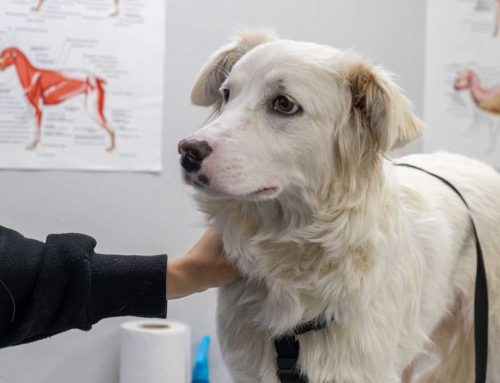


A splenic tumor becomes an emergency when it starts bleeding into your dog's abdomen, and the signs can appear with very little warning. Your dog may suddenly become weak, wobble, collapse, breathe faster than usual, or develop pale or white gums. Some dogs seem profoundly ill for a short time and then perk back up as the bleeding temporarily slows or a clot forms. That improvement can be dangerously reassuring. A splenic mass can begin bleeding again, sometimes more severely, and significant blood loss can quickly lead to shock. If your dog has a known splenic mass, or an older dog suddenly collapses or becomes weak and pale without an obvious explanation, internal bleeding needs to be ruled out urgently.
When a bleeding splenic tumor arrives at Veterinary Emergency and Specialty Center of Northern Arizona, our first priority is determining whether your dog is in shock and stabilizing them while we identify the source of the bleeding. Our Flagstaff hospital has in-house bloodwork, advanced imaging including CT, and the surgical capability to remove a ruptured or bleeding spleen when emergency surgery is appropriate. These cases can change quickly, so a dog who seems better after an episode of weakness or collapse still needs to be evaluated. Our hospital is staffed from Friday at 5pm until Monday at 8am just so your pet can have exceptional care while your regular vet is closed, so if your dog suddenly becomes weak, pale, unsteady, has a swollen abdomen, or collapses over the weekend, call us on the way in.
Splenic Tumors in Plain Terms
- Hemangiosarcoma grows inside blood-rich organs, so a dog can look completely healthy right up until a tumor bleeds.
- Not every splenic mass is cancer, and no ultrasound can tell the difference; only a pathologist looking at the tissue can say for certain.
- A few breeds carry enough risk that adding abdominal imaging to a senior checkup is worth a conversation with your regular veterinarian.
- Treatment aims to buy good, comfortable time rather than a cure, and clinical trials are worth asking about early.
What Is Hemangiosarcoma, and Why Is It So Dangerous?
Hemangiosarcoma starts in the cells that line blood vessels, which is why it settles into blood-rich organs like the spleen, the liver, and the heart, and why the tumors it builds are soft, blood-filled, and prone to tearing. One can grow surprisingly large before anything feels wrong from the outside.
Dogs develop many different types of cancer, but this one is among the most dangerous for a specific reason: it grows in the bloodstream, so it has a ready-made highway to the rest of the body long before anyone knows it's there. A fragile tumor can leak a small amount of blood, clot itself off, and leak again weeks later, which is why some dogs have a rough evening and seem fine the next morning. Then one bleed doesn't stop.
There's an important exception. The skin form, a firm reddish or purple-black bump on thinly haired skin like the belly or inner thigh, behaves far less aggressively than the internal version and carries a much better outlook when it's found and removed early. That alone is reason enough to have any new lump checked while it's still small.
Which Dogs Are Most at Risk, and Can Screening Catch It Early?
The breed and age patterns are consistent year after year: most dogs diagnosed are past middle age, and Golden Retrievers, German Shepherds, Labradors, and Portuguese Water Dogs show up far more often than their share of the dog population would predict, with the lifetime risk for Goldens estimated near one in five.
That number deserves some precision. Four out of five Goldens never develop this cancer, so it isn't a sentence. What it does mean is that a vague off day in an at-risk senior needs a real look instead of a wait-and-see week. No breed is exempt, mixed-breed dogs get it too, and age remains the single biggest factor across the board.
Screening can find a mass before it ruptures, and that changes everything about the day. A planned splenectomy in a stable patient is a completely different event from emergency surgery on a dog who is bleeding into their belly, both for the outcome and for the family standing in the exam room. Screening an at-risk senior usually means adding abdominal ultrasound and chest images to the regular checkup, often twice a year, since routine bloodwork alone won't find a mass. It isn't a guarantee, and a tumor can appear between visits, but it shifts the odds meaningfully. Plan those images with your regular veterinarian, ideally while nothing is wrong. Our team usually meets these dogs the other way, after a collapse on a Saturday morning.
What Are the Early Warning Signs of a Bleeding Splenic Tumor?
Most warning signs of cancer are quiet ones: a skipped meal, a flat day, less interest in the walk that is usually the best part of the afternoon. With a splenic tumor, those signs come and go.
A small bleed leaves a dog weak and washed out for a few hours, the body reabsorbs the blood, and by morning they're bouncing around the kitchen again. Nothing was fixed. The tumor is still there, and the next episode can be much larger. Signs worth acting on even when they seem to pass:
- Sudden weakness or collapse: A dog who wobbles, goes down, and gets back up has told you something important. Cool paws, a racing heart, and gums that feel tacky are signs of shock and need care right away.
- Pale gums: Pale gums, white or gray instead of bubblegum pink, mean blood is not reaching the tissues the way it should, and in a dog who also seems weak or wobbly that is a same-hour problem.
- A belly that looks bigger: A distended or tight abdomen, sometimes with a hunched posture, can mean blood is pooling where it shouldn't.
- Fast breathing at rest: Heavy breathing with no heat and no exercise behind it often means the body is short on oxygen-carrying red cells.
- Vague gut upset with a crash: Vomiting and diarrhea in an older dog who is also weak, pale, or unusually quiet is worth taking seriously.
Never give human pain medication, and aspirin in particular, because it interferes with clotting in a dog who may already be bleeding. Do not press or knead the abdomen, since a fragile tumor tears easily. And don't wait out the "he seems fine now" window. On weekdays, your primary veterinarian is the first call; over the weekend, come straight to us in Flagstaff.
How Do We Diagnose a Splenic Mass?
Diagnosis is built in layers, starting with the least invasive. An abdominal ultrasound can show a mass on the spleen and, just as importantly, whether free blood is already pooling around it, usually within minutes of a dog walking through the door.
Bloodwork runs alongside it, giving us a red cell count, platelet numbers, clotting times, and organ values while your dog is still on the table. When a tumor tears open and blood fills the belly, the word for it is hemoabdomen, and for far too many families it is the first moment anyone learns the cancer was there at all.
Chest images matter as much as the belly. Radiographs show whether nodules have already reached the lungs, which changes the conversation before anyone commits to surgery, and our CT scanner maps the abdomen and chest in more detail when the picture isn't clear.
| Test | What it shows | Why it matters |
| Abdominal ultrasound | A mass on the spleen and free fluid around it | Finds active bleeding without surgery |
| Bloodwork and clotting times | Red cells, platelets, organ values | Shows how much blood has been lost and whether clotting is failing |
| Chest radiographs | Lung nodules, fluid around the heart | Looks for spread before a surgical decision |
| CT | A detailed map of the abdomen and chest | Answers questions ultrasound can't in one study |
| Tissue biopsy after removal | The actual cell type | The only test that names the cancer for certain |
Could the Mass Be Benign Instead?
A splenic mass can't be sorted into cancer or not cancer by how it looks on a screen, no matter how experienced the person holding the probe. Removing the spleen and sending the tissue to a pathologist is the only way to know, which is why that surgery so often serves as treatment and diagnosis at the same time.
A meaningful minority of splenic masses turn out to be something other than hemangiosarcoma, and removal cures them outright:
- Hematoma: A contained pocket of clotted blood, often left behind by a small bleed, and identical to a tumor on imaging.
- Nodular hyperplasia: Ordinary overgrowth of normal spleen tissue, common in older dogs and harmless.
- Hemangioma: A benign tumor of the same blood-vessel lining cells, which stays put instead of spreading.
Some families end up with far better news than they braced for on the drive in.
Can Hemangiosarcoma Affect the Heart?
This cancer can start in the heart or spread there, most often on the right atrium, where a bleeding tumor fills the sac surrounding the heart and keeps it from filling and pumping normally. Fainting, a sudden drop in exercise tolerance, and collapse are the usual signs, sometimes in a dog who also has a splenic mass.
The fluid buildup itself is called pericardial effusion, and when there's enough of it to squeeze the heart, that's cardiac tamponade. Irregular rhythms, or arrhythmias, are common too, and they change how much activity a dog can handle and how safely they tolerate anesthesia. Fluid backing up can also push into the chest and abdomen, so respiratory distress, a swollen belly, or breathing that looks like work at rest belongs in the same urgent category. Ultrasound of the heart shows the fluid and often the mass itself, and an EKG reads the rhythm.
What Are the Treatment Options for Hemangiosarcoma?
Treatment centers on removing the tumor when that's possible, then using medication to slow the microscopic disease left behind. The honest goal is buying good, comfortable time rather than promising a cure, and the right plan depends on where the tumor sits, how your dog feels, and what fits your family.
- Surgery: Removing the spleen stops the bleeding and hands the pathologist the tissue that names the disease. A dog who has lost a lot of blood may need a transfusion around surgery and usually stays in the hospital a night or two afterward. Dogs live perfectly well without a spleen, and most are back to themselves within a couple of weeks.
- Chemotherapy: Given after surgery, it targets the cells imaging can't see, and most dogs tolerate it far better than people expect, because doses are chosen to protect quality of life.
- Immune-based and radiation treatment: Immunotherapy takes a different route than chemotherapy, aiming to teach a dog's own immune system to recognize and go after cancer cells.
- Comfort-focused care: Pain control, anti-nausea medication, and close monitoring at home make a real plan, not a decision to do nothing.
Chemotherapy and ongoing oncology care take place at a veterinary cancer center rather than at our hospital, and we'll make the introduction and send your dog's records and images along so nothing has to be repeated.
Newer Treatments Worth Asking About
Experimental therapies for this cancer are enrolling dogs at veterinary teaching hospitals right now, and eligibility often depends on what a dog has already been given, which is why the question is worth asking at the beginning rather than after the first rounds of chemotherapy. Research into earlier detection and longer control is funded and active, and it's the reason the options on the table today aren't the ones families were offered ten years ago. Trials aren't right for every dog or every household, and none of them come with a promise. They're simply worth raising early, while every door is still open.
How Long Do Dogs Live After a Diagnosis?
Survival times vary a great deal, and they depend most on which organ the tumor started in and whether chemotherapy follows surgery.
| Situation | General expectation |
| Spleen removal alone | Often a couple of months, sometimes longer |
| Spleen removal plus chemotherapy | Roughly double, with a smaller group doing considerably better |
| Skin-only form, removed early | Frequently years, and occasionally cured |
| Heart-based tumors | Usually shorter and highly variable, depending on how well fluid can be controlled |
Where any one dog lands also depends on how far the disease has spread and how they feel on an ordinary Tuesday. These figures describe groups, never your dog exactly, which is why the plan involves rechecks, repeat imaging, and adjustments rather than treating a number on a page as a schedule.
How Do Families Decide What to Do?
Most families are asked to make a decision about surgery and cancer care within hours of hearing the diagnosis, so the practical questions and the grief arrive together. There's no single right answer, and understanding what each path involves is what makes a choice feel considered instead of rushed.
Pursuing every available treatment is an act of love. So is choosing comfort-focused care from the first conversation. Our job is to lay the trade-offs out plainly, including what a plan realistically asks of your household, and to keep the decision where it belongs, which is with the people who know this dog best.
What Dog Families Ask Us About Splenic Masses
Could I have caught this sooner?
In nearly every case, there was nothing to catch. Hemangiosarcoma grows inside an organ where nothing can be seen or felt, it doesn't cause pain until it bleeds, and it rarely changes routine bloodwork. Families who fed well, exercised their dog, and never missed an annual exam still end up here. Noticing the collapse and getting your dog in quickly is the part that was yours to do, and you did it. In some cases, a routine screening by ultrasound can catch these tumors early if you have an at-risk senior breed, but even then these cancers can grow quickly and bleed unexpectedly.
Can cats get hemangiosarcoma too?
Cats do develop it, though much less often than dogs, and it shows up in the spleen, liver, skin, or under the skin. A splenic mass in a cat is more likely to be mast cell disease or lymphoma, so the workup looks a little different. The warning signs are the same though: weakness, pale gums, hiding, a skipped meal or two, and faster breathing. A cat with those changes needs to be seen just as urgently.
Is sudden collapse always internal bleeding?
Sudden collapse has other causes too. An abnormal heart rhythm, low blood sugar, a toxin, a severe allergic reaction, or heat stroke on a warm afternoon can all drop a dog without warning. Every one of those is an emergency in its own right, and none of them are safe to sort out at home. Bloodwork and imaging usually separate them quickly, which is why a dog who collapses needs to be examined even if they seem fine again by the time you find your keys.
Finding Good Days After a Splenic Tumor Diagnosis
This is heavy news, and it isn't the end of good days. Plenty of dogs go back to the couch, the creek, and the same three sniff spots on every walk, and that ordinary time is worth a great deal. Rechecks, repeat imaging, and honest conversations about how your dog is doing at home let the plan shift as things shift, which is how comfort stays protected.
If your dog has a known splenic mass and something feels wrong this weekend, our Flagstaff hospital is staffed and ready, and your regular veterinarian is the first call during the week. To talk through what comes next, reach out to Veterinary Emergency and Specialty Center of Northern Arizona. You don't have to figure this out by yourself.